
Emma Jean and No Access to My Pain

Damn it! I have been working on the poem Emma Jean from Atheists and Empty Spaces Revised for over a week, and as I got ready to publish it this morning, I feel like I haven't significantly changed anything. Yes, I have revised a lot. Some of the verses are completely different. However, the poem is not improved. It's just different. I chickened out on my claim that I would start from scratch. I didn't. Anyway, here it is. In between revisions of Emma Jean, I did rework No Access to My Pain, and I think that I improved that poem quite a bit. See what you think. As always, ENJOY!
Emma Jean
Part 1: One Day I Can See
Just off the rolling, lusty hills,
Where all night long the whippoorwills
Sing down the softly sloped incline,
Through whiskered oak and rigid pine,
And over mossy sandstone crags
Where mist mellifluously drags
Through the creek like cotton candy
In a spinning machine
Lives a will-o’-wisp named Emma Jean.
Sightless since the scarlet fever
Stole her vision like a reaver,
She tries her best to recreate
The blushes of a sighted state,
But she forgets what most is true.
The fever filched her mother too
And left no color for her art.
An ample talent, thus, is flawed
With no hues in her broken heart.
Lost with that tint, so too a guide
Down paths of a more sensual side,
For Father’s face, much like her own,
Is hardened to a polished stone,
Pleasant enough to gaze upon
Until you see the fire is gone,
And of desires, she knows not what,
Nor has a soul to teach,
The methods to escape her rut.
So, pink has disappeared, and red
Was never in her virgin head.
Rosy urges, pale and tame,
Fade with a yellow sense of shame,
And though she should relate to blues,
The saddest of the many hues,
She shuns them just to keep them down.
With all the colors lacking,
Her art is senseless, tasteless brown.
Her paintings show no green nor red.
Yellows and blues to her are dead,
Bleak memories of what was sight
Before her world turned black and white
And all her upsides drifted down.
She only dips her brush in brown,
The hue she does not want to be
Though it is how she feels,
Lacking a female family.
Some say she paints by sense of smell,
Which no one feels can work too well.
With such distinctive scents around,
She might as well picture a sound.
An echo’s portrait seems absurd,
But brown is quite a silent word
And midnight raindrops shushing down
On her cabin’s tin roof
Bores so broadly it sounds like brown.
People come from neighboring towns
To buy the blind girl’s dabbled browns
Daubed on toothed blades from old mills
That trimmed the timber of these hills.
They pay as much as fifty bucks
To stare at scenes with abstract looks,
And wonder what it is she sees,
And guess what is not seen,
In monochromatic memories.
When patrons come to get the blade
Of rustic art for which they’ve paid,
They say of sawblades decked in brown,
“What a beautiful bear or tree or fawn!”
And Emma evasively smiles
And flexes her artistic wiles.
“It is whatever you want it to be,”
She waxes philosophically,
“I pray that one day I can see.”
Thus, pity keeps fans coming back
To feign the love of art they lack.
Alone with Father and her fame,
Each day, each year passes the same,
None the better, none the worse,
Which is the core of any curse,
But neither of them thinks it odd,
That in this empty life,
They blame her blindness on God.
Maybe not “God,” but some benign spirit
That causes pain so Man might fear it,
Yet who offers shelter for a soul
When its life gets beyond control
Or its abode, as that may be,
Besieged by some dark deity.
Atheists only learn to hate
The most negligent excuse,
“My life is not mine. It belongs to Fate.”
But Father supports this point of view
And clings to it as most men do
Whose children suffer random ill
That has no cure sealed in a pill.
Her art goes on denying griefs
And faith goes on through blind beliefs,
But sometimes thoughts begin to stir
As healthy needs arise,
And these urges do much to disturb her.
Part 2: A Man of Many Angles
One summer morning after hay,
When busy work is put away,
When locusts drone and light has weight,
She thinks she’ll paint a horse’s gait,
Its neigh, its scent, its clip and clop,
The ripple of its skin but stop!
She hears the ring of steel on stone,
A horse trots up the creek
With a rider, and she fancies him alone.
She dreams him in a wind-worn hat
Pulled low over his face so that
His eyes are hidden from the sun.
His cowboy scarf, a ragged one,
Is loosely tucked into his shirt.
His blue jeans bound with leather girt
Are neat but fraying at the seams,
His leather boots are worn.
He’s like a lover she’s held in dreams,
And this scene sets her eyes to smiling.
Just to make him more beguiling,
She imagines a confidence
That is quite nearly arrogance
In the way he sits his saddle.
Then, she slyly adds a rattle
Since she smells a certain peril
In his sensual odor
That is bafflingly sweet but feral.
She fancies a man not young nor old,
A voice that’s warm, a heart that’s cold,
Rough hands with strength but warm to touch,
White teeth that shine a bit too much,
A wiry frame concealing might,
A shadow not repelled by light,
And when she senses he is near,
Those feelings fly away
As his breath blows in her ear.
With a southern drawl as smooth as silk
And as buttery as fresh-squeezed milk,
“What is this thing?” he asks of her
“Why, it’s you on your fine horse, sir,”
She admits with a finishing stroke.
“Surely, you tell a feeble joke,”
He laughs, “All that I see is brown.”
All she can see is bits
Of light as she comes falling down.
With no guidance in female charms,
She fakes a faint into his arms,
And finds that he is not surprised
By coquetry so ill disguised.
He lifts her smoothly to her feet.
She smells his skin, she feels his heat
His beard put her hair in tangles,
She perceives his point
And ponders its many angles.
“I’m sorry that I spoke out of turn,”
He says as her cheeks begin to burn,
“But it had never crossed my mind
That any painter could be blind.
Still, if I may offer sage advice,
A little coloring would be nice.
Adding some pinks and purples
Might liven this dull art
And appeal to more realistic circles.”
“Your perspective is not like mine.
I think my painting is just fine.
I make money. I fill a need.
Purple, pink, colors, indeed!
And what would colors do for me?
Do you think that they’ll help them see?”
She screeches as her nostrils flare,
She’s so excited,
But the anger gives her quite a scare
As colors flash through her blank mind,
The first she’s seen since she’s been blind.
“Colors, sir, are not what I can feel.”
She lies while feeling boundless zeal,
“Besides, I know where emotion leads.
First to desire, then other deeds
That bring a foolish woman down.
I will not be seduced by…”
And her fervor fades into a frown.
With her senses so keenly drawn,
She notices his aura gone
As if some breeze had blown him by
Or some great spirit in the sky
Had pulled him back into the brown
And left her burning all alone.
Then, just as quickly, his scent returns,
He touches her hand
And his stroke, like acid, burns.
“Try this,” he says, and on her nose,
He dabs the petals of a rose,
And lightly slides around her face,
The perfumed leaves as if to trace
A form onto her passive soul.
A sob escapes; out of control,
Her darkened eyes begin to weep,
“Please, stop. I can’t do this,”
She says, “My morals run too deep.”
But then a weight presses her lips
And something sweet and sticky slips
Between them and alerts her tongue
To yearn for fragrant fruit that’s hung
Tantalizingly close at hand.
“This is more than I can stand,”
She cries, “Please tell me what to do.
Forgive my artlessness,
But here I am. What can I give to you?”
His hand clasps firmly on her wrist
“I’ll only take what you insist
And give you what you need for now,”
He murmurs as he smooths her brow
With warm and tender angel’s lips.
She puts her hands upon his hips
And trembling wholly pulls him near.
“We must be quick,” she moans,
“For Father won’t approve, I fear.”
Still in the languid afterglow,
Sun beams, like golden honey, flow
Around her naked arms and thighs
“I know that you must have green eyes,”
She utters as her fingers find
And feel his eyelids, “In my mind,
Their hue is like a walnut leaf
Or an emerald
Or waters around a coral reef.”
He nips her hand with a quick kiss.
“Your world is color after this,”
He says and rises from her bed
“Your anger may be dark but red,
Your sadness might be tainted blue,
But every mood will have its hue,
And here is the important part,
Do not forget this!
I’m now and will forever be your Art.”
Without a sound, a scent, or trace,
His essence fills then leaves the place,
And Emma Jean is all alone
Quenched with color to the bone.
With tranquil mind and body yearning
Back into her pleasure turning,
She sifts her fingers through her hair,
And wildly wonders,
Was the stranger ever really there?
Part 3: What Passions Conceive
Through the evening hours, she gathers
Passions bright as peacock feathers.
An art she’s never felt before
Beams a sun-shaft to her core
Filling the pink of virgin lips
With red perfumes of rosy hips
And guiding timid searching hands
Through violet
And sunset blushes of exotic lands.
Now, twilight falls over the hills
And doves moan out their parting trills,
The orange moon floats in lilac skies
And Emma, feeling blue, just sighs.
A glow beneath her bedroom door
That never has been closed before
Tells her that Father waits outside
Confused, bemused,
But not able to swallow his pride.
With cautious air but easy charm,
She sits by him and takes his arm,
“I’ve been asleep for hours it seems,
And had the most unusual dreams.
Perhaps next time you go to town,
You’ll get some other paints than brown.
It’s time for me to test the feel
Of sensation
And recreate a world more real.”
He only sees her hair astray,
A confidence, a curve, a sway,
An aura of experience
Where once was only innocence.
He notes two buttons and the eyes
That open to the prying skies,
Revealing curves of swelling breasts,
That tempt lustful eyes
And encourage unwelcome guests.
.
He doubts that she’s aroused herself,
But how? Seduced by someone else?
She’s just a girl and has no mother,
How would she know to find a lover?
She will be used; my God, she’s blind.
Such thoughts are all that fill his mind
“I hope to God he’s gone away.”
He says wearily,
Uttering words he thought he’d never say.
“Father, dear Father, do not fear,
I am and always will be here,
But there is a deep change in me,
A light I’ve felt that makes me see
How all my art was full of sin
By holding what I feel within
And keeping all sensation out
Of art and me.
I think I’ve learned what life’s about.
Tonight, I will delight in dreams.”
The silence hangs for hours it seems
As Father thinks what this may mean,
To him, to art, to Emma Jean
“But, you are…,” he begins to say
As she gets up and glides away
Like a moonbeam across the floor
“Shhh,” she says,
And closes his thoughts with the bedroom door.
Out her window, the glowing light
Fills the empty spaces of night
With spirits from the lands of dream.
On her brow, an heraldic beam
Sparks miracles inside her mind
And shows her why she has been blind
And how tomorrow she shall see
What passions conceive
And how they set the whole world free.
Just off the rolling, lusty hills,
Where all night long the whippoorwills
Sing down the softly sloped incline,
Through whiskered oak and rigid pine,
And over mossy sandstone crags
Where mist mellifluously drags
Through the creek like cotton candy
In a spinning machine
Lives a will-o’-wisp named Emma Jean.
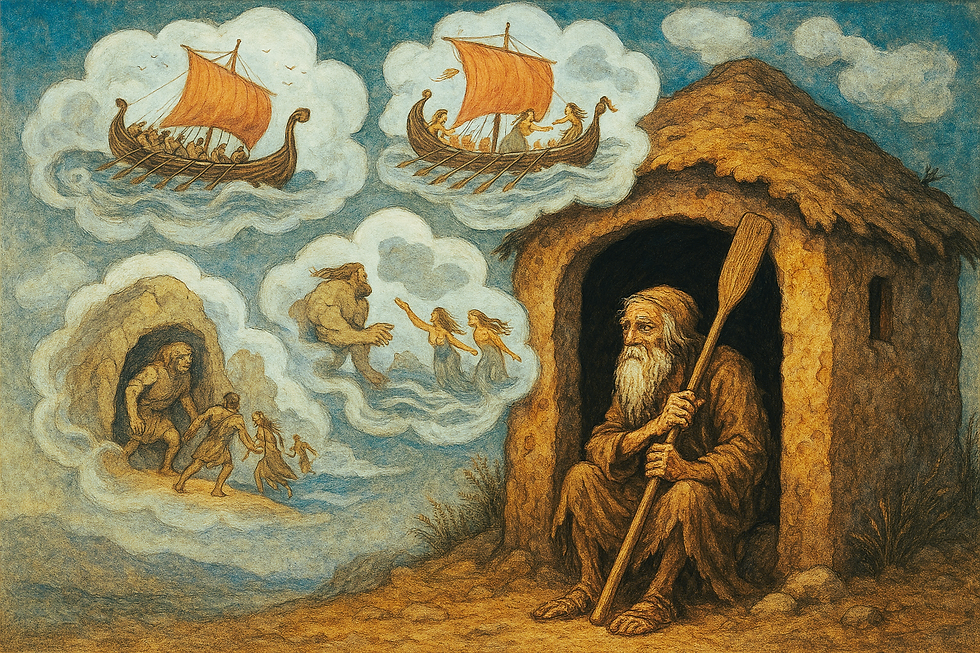
No Access to My Pain
They have no access to my pain,
They cannot sense my wandering thoughts,
They are not ghosts inside my brain,
So all I am to them is lost.
My story is a troubling tale,
In which my friends are damned to hell,
But all my rivals die as well
Because they saw my tattered sail.
I brought with me a galley oar
And walked inland to find a home
Till someone asked me, “What’s that for?”
And now, I sit here all alone.
I have no walls, no guarded gate.
I have no will to keep them out,
For all my love and all my hate
Have surely died with all my doubt.
I pitch no prayers to empty space,
I pour no wine on this terrain,
And should I name them in this place,
They have no access to my pain.


Comments